REVERSE PROPAGATION
Last year, you taught me how to propagate succulents—cut cleanly at the node so the wound can callus over before planting or else rot will set in—while I watched you demonstrate on the jade plant your ex gave you before she left, occasionally running your thumb over the severed stem. Botanists tend to promise long life of plants even after damage. This is something you told me while trimming my hair in your bathroom—scissors so close to my ear I had to hold my breath for god knows how long—later adding I looked better shorter because long hair made it seem that I was trying too hard. You told me several other things later that week. How thorns are but modified leaves, how everyone gets close without paying for it—all while you’d report your barrel cactus and admire its three hundred sixty degree protection. Occasionally, I’d pay you small currencies. Stopped seeing Alex because you said they flirted with me, stopped wearing the kalamkari shirt my mother bought for my birthday, quit asking why you needed my phone password all of a sudden. Horticulturalists know that some plants are allelopathic. They release chemicals that prevent other plants from growing nearby. Black walnut trees kill everything beneath them. If I tell you, you’d laugh at this fact, and perhaps even say it reminded you of your mother. I almost said it reminded me of you. When you pushed me it was into the bookshelf, an accident you said, and the succulent on the top shelf survived even though it shattered, because they are resilient like that, and I replanted it while you apologized over and over, cried and rambled how you’d never forgive yourself, and how by next morning, I’ve already forgiven you. Research shows plants remember trauma. Meaning, when our mimosa plants stop closing their leaves after being dropped repeatedly, it’s only because they’ve learned that fall isn’t that fatal. I learrned to duck when you reached overhead, apologize for things I didn’t do. In another world, you’d give me roses and sunflowers. In this one, you bought me a Venus flytrap for our anniversary as it was romantic. Queer, both predator and flower. But the plant uses so much energy in the snap that each trap can only close four or five times before it dies. I grew new versions of myself every few weeks, each one smaller than the last. Scientists proved plants scream when stressed, except in frequencies beyond the human range. I wonder what frequency I was screaming at. If you heard it and thought it was growth.
BONSAI TECHNIQUES FOR BEGINNERS
Eating a pear, I thought of my girlfriend. How she coiled a copper wire on the table in front of us us while the instructional video froze at 4:23. The bonsai master’s hands were still suspended mid-gesture, & she said you have to know when a branch is flexible enough for it to take the shape you want it to take. If it’s too old, it’ll snap clean. I was but twenty-three, young enough, she said, to be trained. So she wrapped the wire around my left, non-tattooed wrist to demonstrate correct tension—not enough to cut off circulation but enough. Enough that I’d feel it for hours after, for my wrist to wear a red bracelet I couldn’t take off anymore. The roots have to be trimmed, she explained, sliding her manicured thumb along the root ball to break off the fine hairs, otherwise they grow too wild and reach in directions that don’t serve the tree’s beauty. I watched her cut away half the system with scissors worth more than anything I owned. The white threads in the sink looked so much like my grandmother’s hair when she’d let it loose. Oftentimes, she’d say I never paid attention to the right things, which is to say I laughed too loud & held my fork worse than a toddler would, at her colleagues’ parties. Even my body was wrong in small yet ‘fixable’ ways if only I cared enough to fix them. I had spent years making myself legible to a world that didn’t want me—wrong gender, wrong desire, wrong country of origin—and then I fell in love with a woman who offered to finish the job. The wire is temporary, she told me. A year, two at most, & then you remove it but by then the branch has grown a skin of memories and its shape is permanent. Now I wonder if she knew what she was saying or if cruelty really shares the same tone as instruction when one does it long enough. Bonsai is from the Japanese bon (tray) & sai (planting), which explains why the whole art is about making a large something understand it was always meant to be small, & I made myself small. I slept curled on my side because my girlfriend said I took up too much space in the bed; stopped texting my female friends from high school because she’d check my phone in the shower, not out of distrust, she said, but love, means no branch of yourself should grow where her eyes won’t reach, & I believed her because what else do you believe when someone is holding wire. She bought me a book on my birthday, bonsai techniques for beginners, with a note inside that read: thought you’d find this interesting, the discipline of small things, & I did find it interesting. God, I did. The instructor’s hands so gentle they left scars in the cambium layer, the excruciating seconds after she paused the video to point out how beautiful the wound was. That night when she held my face & told me I was finally— finally!—becoming the version she’d always seen potential for, I said thank you; I’d learned that much at least, being grateful for my own trimming. Years later my roommate asks whether taking up so little space even in a bed meant for two is a habit or—
& I say muscle memory, I don’t know. Anything but the truth, which is that certain shapes don’t need the wire anymore to keep once learned.
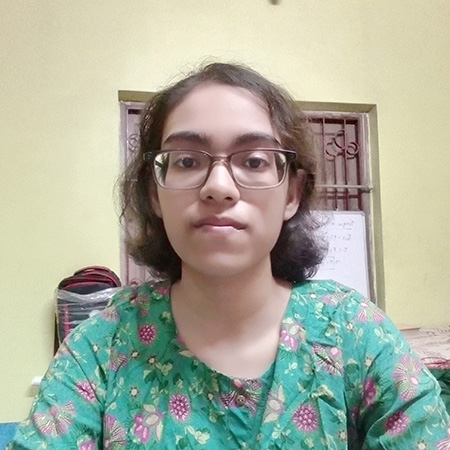
Sreeja Naskar is a young poet based in India. Her work has appeared or is forthcoming in ONE ART, IS&T, Marrow Magazine, Temz Review, Blue Marble Review, The Lake, South Broadway Press, and elsewhere.